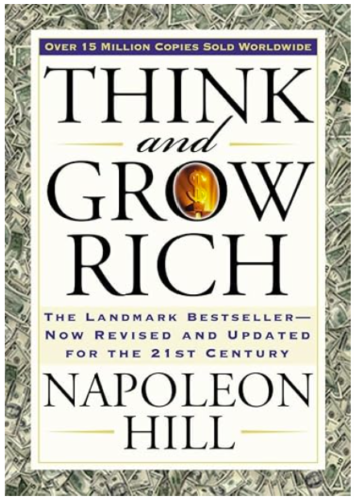
Think and Grow Rich
This Book's Focus
In Think and Grow Rich, Napoleon Hill teaches that success begins in the mind. Published in 1937, this classic grew out of what Hill described as 25 years of studying more than 500 successful people to understand the principles behind their achievements.
His central message is that we must move from failure consciousness to success consciousness. It begins with a definite purpose, a burning desire, faith in our ability to achieve it, and a willingness to take action.
Hill believed that riches must first become real in our imagination before they can become part of our physical experience. And his principles extend beyond money to achieving whatever goals we choose for our lives.
Principles and Keywords
Hill presents 13 principles of success, including:
- Desire — Knowing exactly what you want and developing a burning desire to achieve it.
- Faith — Believing in your ability to turn your desires into reality.
- Autosuggestion — Using repeated thoughts and affirmations to influence the subconscious mind.
- Imagination — Seeing and feeling your desired outcome before it becomes reality.
- Organized Planning — Turning desire into action through definite plans.
- Persistence — Continuing toward your goal despite setbacks.
- The Master Mind — Combining knowledge, experience, and cooperation with others to achieve a common purpose.
Hill emphasizes that wishing for something is not the same as being ready to receive it. Desire must be supported by belief, commitment, and action.
The Blended Path
Think and Grow Rich brings together the practical and metaphysical sides of The Blended Path.
Hill teaches definite goals, planning, persistence, and cooperation while also exploring the power of thought, imagination, and what he describes as Universal Intelligence.
His philosophy reflects the belief that we can consciously direct our lives through both purposeful action and the creative power of our minds.
Why I Value This Book
What fascinates me about Think and Grow Rich is that Hill was teaching the psychology of success while also exploring the spiritual power of thought.
One story that stayed with me is his account of his son Blair, who was born without external ears and with severe hearing impairment. Hill refused to believe that his son’s condition would determine what was possible for him. He encouraged Blair to believe in his ability to hear, and Blair eventually found a way to experience hearing through technology.
Hill saw this as a demonstration of the power of faith, desire, and belief. I find it a compelling personal example of how he understood the metaphysical principles he taught.
I have always been drawn to the idea that our thoughts become things, and Hill connects that belief with practical principles for achieving our desires.
For me, this book is about much more than accumulating money. It is about recognizing our creative power and learning to use it intentionally to shape the lives we want to experience.
As an Amazon Associate, A Daily Focus earns from qualifying purchases at no extra cost to you.